History Revealed
This week I have been starting to immerse myself within the new module of History and Futures. I do not yet understand the brief, but I am waiting for the project briefing that will happen this Thursday. The main thing I have been looking at this week is the content within Canvas.
Lecture notes
- Identity is everything
- ‘Invoke the response that you want, while visualising something in a new way’ – Paula Scher
- Expressing individuality
Eddie Opara
Opara is an American typographical designer that explores the idea of using typography as texture within designs.


https://www.pentagram.com/news/eddie-opara-designs-custom-typeface-for-vineyard-theatre-identity


https://www.itsnicethat.com/news/pentagram-eddie-opara-mellon-foundation-graphic-design-060422

The use of typography as texture is a concept that has always interested me and the results when executed correctly are visually stunning. The fact that you have to interact with the type to see a visual output is a really curious and engaging concept and is something that I would love to try and implement into my work when I can.
‘WORDS HAVE MEANING. TYPE HAS SPIRIT’
Paula Scher
GUTENBERG – TYPE PRINTING PRESS

- The Gutenberg printing press was a mechanical press that used movable metal type to print pages of text. It was invented by Johannes Gutenberg, a German goldsmith, around 1440
- How it worked
- Movable type: The press used individually cast letters and symbols that could be arranged on a matrix to form words.
- Matrix: The matrix was mounted on the press and lowered onto paper.
- Ink: Gutenberg created an oil-based ink that transferred well from the metal type to the paper.
- Flattening paper: Gutenberg used a winepress to flatten the paper.
- The Gutenberg printing press made books more accessible to the general public.
- It started the Printing Revolution, which changed the way people accessed information.
- It led to the development of typography and fonts.
STENCILLING
Stencilling is a technique that uses a stencil to transfer an image or pattern onto a surface. The stencil is a thin sheet with holes cut into it to form the design. The pigment is then applied through the holes to create the image.
How it works
- Place the stencil over the surface you want to decorate
- Apply the pigment through the holes in the stencil
- Wipe away the stencil and reuse it
What materials can be used?
- Stencils: Can be made from paper, wood, metal, or plastic. Plastic stencils are easier to clean.
- Pigment: Can be ink, paint, pencil, or marker. Thicker paint is better for stenciling.
- Surfaces: Can be paper, card, fabric, walls, or furniture
Uses
- Art: Stenciling is a simple form of printmaking that can be used to create fine paintings, mimeographs, and more.
- Decorating: Stenciling can be used to decorate walls, furniture, and other surfaces.
- To avoid bleeding, don’t slap the paint onto the surface.
- To get crisp edges, tap the paint onto the stencil up and down, not sideways.
- Acrylic and chalk paints work well for stenciling on walls and furniture.
Ghost Signs
Ghost signs are old, hand-painted advertising signs that are preserved on buildings that have changed use. They are often faded, which is how they got their name.
- Ghost signs are a key part of a city’s history.
- They can be found in urban areas, often hidden in plain sight.
- They can be found on buildings that have changed use, such as old shops.
- They can be a window into how buildings have changed over time.
- They can show what products were popular and how they were advertised.
- They are often hand-painted in lead-based paint.
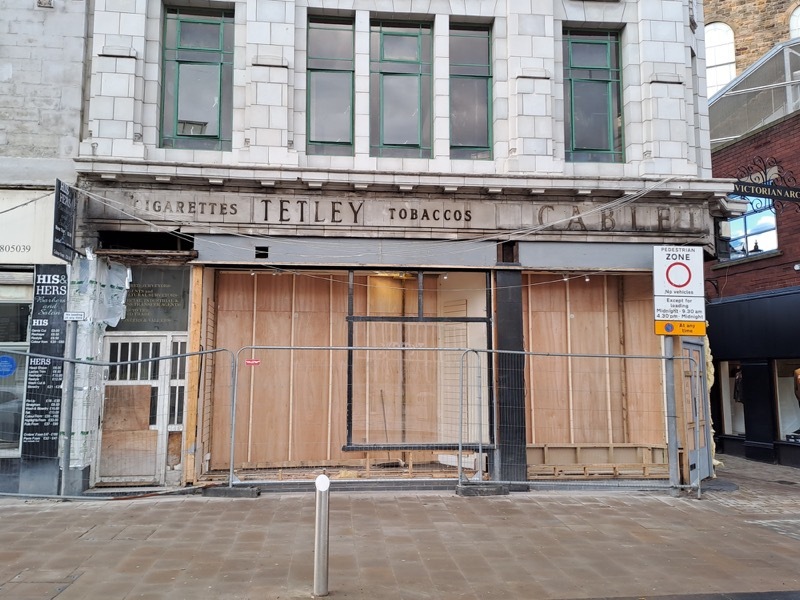
Signs from the Tetley tobacconist (36 Eldon Street, Barnsley) and Cable Shoes (38 Eldon Street, Barnsley) have revealed some previously unknown history about the building, including previous businesses and changing trends and tastes over the decades.
 LSJ DESIGNS
Leave a comment